Article 1: Congress Explained
Learn about the powers, structure, responsibilities, and lawmaking process of Congress under Article 1 of the United States Constitution.

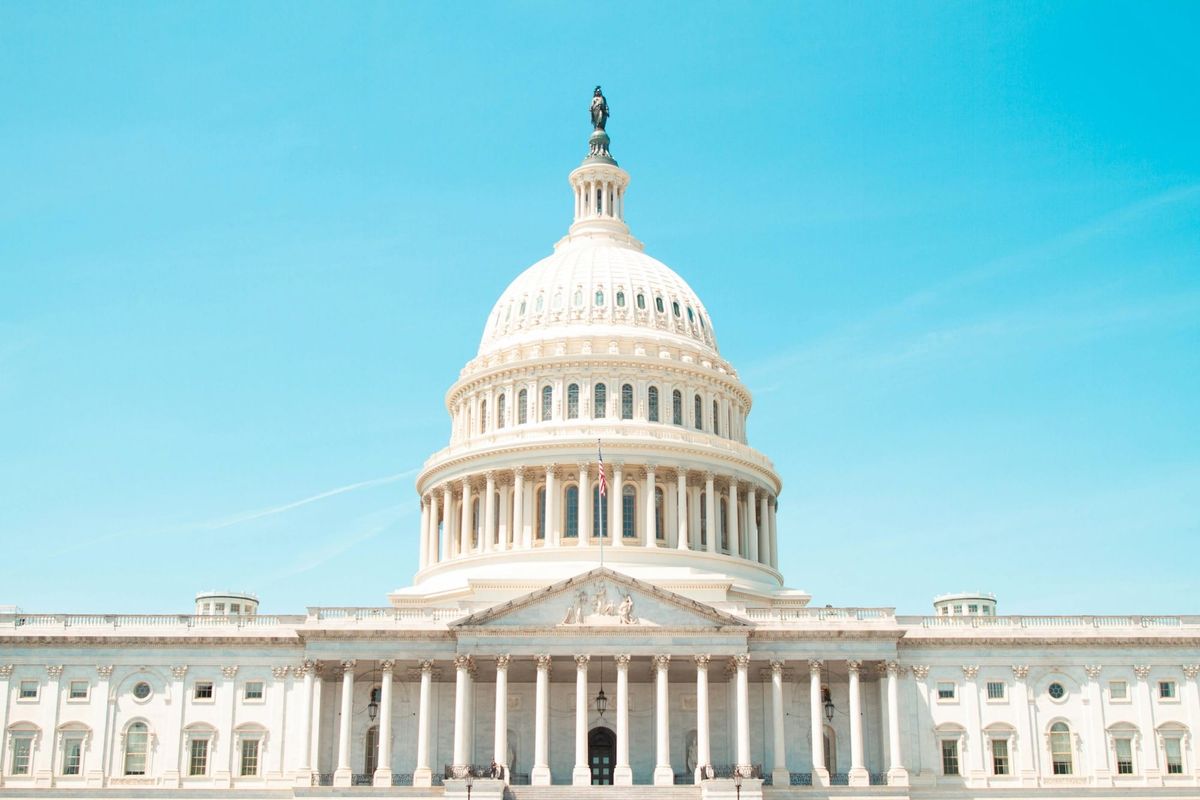
Article 1 is the first article of the U.S. Constitution. It creates the Legislative Branch, also known as Congress, and gives it the power to make federal laws. Congress is divided into two parts:
Who Makes Up the Legislative Branch?
The Legislative Branch consists of Congress, which is divided into 2 parts:
- The Senate
- The House of Representatives
The Senate
- 100 Senators
- 2 Senators from each state
- 6-year terms
Responsible for:
- Voting on new federal laws.
- Approving the President's choices for Cabinet members, federal judges, and Supreme Court Justices.
- Approving formal agreements between the United States and other countries.
- Holding trials after the House of Representatives votes to impeach a federal official.
The House of Representatives
- 435 Representatives
- The number of Representatives each state receives is based on its population
- 2-year terms
Responsible for:
- Voting on new federal laws.
- Introducing bills that raise or lower taxes and other bills that affect federal revenue.
- Beginning the impeachment process for federal officials.
- Representing the communities and neighborhoods each Representative is elected to represent.
What Does Article 1 Do?
Section 1: Creates Congress
Creates the Legislative Branch, known as Congress, and gives it the power to make federal laws.
Section 2: Creates the House of Representatives
- Requires Representatives to be at least 25 years old.
- Requires Representatives to have been a U.S. citizen for at least 7 years.
- Requires Representatives to live in the state they represent.
- Requires Representatives to be elected every 2 years.
- Distributes House seats among the states based on population.
- Gives the House of Representatives the sole power to formally accuse a federal official of misconduct and begin the process that could remove the official from office.
Section 3: Creates the Senate
- Gives each state 2 Senators.
- Requires Senators to be at least 30 years old.
- Requires Senators to have been a U.S. citizen for at least 9 years.
- Requires Senators to live in the state they represent.
- Sets Senate terms at 6 years.
- Gives the Senate the sole power to decide whether a federal official should be removed from office after the House of Representatives has formally accused the official.
Section 4: Establishes Congressional Elections
Allows state governments to set the time, place, and manner of congressional elections, while allowing Congress to change those rules. Requires Congress to meet at least once every year. Under the Twentieth Amendment, Congress begins each new term on January 3, unless a different date is established by law.
Section 5: Establishes the Rules of Congress
Allows the House of Representatives and the Senate to:
- Decide whether newly elected members meet the constitutional qualifications to serve.
- Create their own rules.
- Keep a public journal of their proceedings.
- Discipline members for misconduct.
- Remove a member with a two-thirds vote.
Section 6: Establishes Congressional Pay and Restrictions
Requires members of Congress to be paid for their work. It prohibits members of Congress from holding certain federal offices while serving in Congress to reduce conflicts of interest.
Section 7: Creates the Federal Lawmaking Process
Most bills may begin in either the House of Representatives or the Senate. Bills whose main purpose is to raise money for the federal government, such as tax bills, must begin in the House of Representatives.
The section also requires:
- Approval by both the House of Representatives and the Senate.
- The President to sign or veto the bill.
- A two-thirds vote in both chambers to override a presidential veto.
Section 8: Lists the Powers of Congress
- Collect taxes.
- Borrow money.
- Regulate trade.
- Print and regulate U.S. currency.
- Establish post offices.
- Create federal courts below the Supreme Court.
- Declare war.
- Raise and support the military.
- Pass laws needed to carry out its constitutional responsibilities.
Section 9: Limits the Powers of Congress
Prohibits Congress from taking certain actions, including:
- Granting titles of nobility.
- Spending money unless approved by law.
- Congress usually cannot suspend habeas corpus, which is a person's right to ask a judge whether they are being held in jail legally.
- This right may be temporarily suspended only during a rebellion or if the United States is attacked by another country.
Section 10: Limits the Powers of the States
Prohibits states from:
- Making treaties with other countries.
- Printing their own money.
- Declaring war except when the state must immediately defend itself from an attack.
- Granting titles of nobility.
- Passing laws that conflict with powers given to the federal government.
What Does Article 1 Do?
Article 1 gives Congress the power to:
- Write and pass federal laws.
- Collect taxes.
- Borrow money.
- Regulate trade with other countries and between the states.
- Declare war.
- Raise and support the military.
- Create federal courts below the Supreme Court.
- Print and regulate U.S. currency.
- Establish post offices.
- Approve the federal budget.
(1) U.S. District Courts – Where most federal cases begin.
(2) U.S. Courts of Appeals – Review decisions made by District Courts.
(3) Congress has also created several specialized federal courts, such as the U.S. Tax Court and the U.S. Court of International Trade, for specific types of cases.
How Does Article 1 Work?
A bill is a proposed law and before a bill becomes a federal law:
- A bill is introduced in either the House of Representatives or the Senate. (Bills that raise taxes must begin in the House of Representatives.)
- Members of both chambers review the bill, discuss possible changes, and vote on it.
- The House of Representatives and the Senate must both approve the bill.
- The President signs the bill into law.
Where Does Article 1 Apply?
Article 1 applies throughout the United States.
- Congress
- Federal laws
- Federal agencies
- U.S. citizens
- Businesses operating under federal law
Why Was Article 1 Established?
After the American Revolution, the Articles of Confederation created a national government with limited powers. Congress could not effectively collect taxes, regulate trade, or respond to national problems.
Article 1 created a Legislative Branch with defined powers while still placing limits on what Congress could do.
When Was Article 1 Approved?
Article 1 was written during the Constitutional Convention in 1787.
It became part of the U.S. Constitution on June 21, 1788, when 9 of the 13 states approved the Constitution. The new federal government began operating under the Constitution on March 4, 1789, about 8 months later.
 MIMS Reports
Disclaimer
This content was researched and organized with the assistance of artificial intelligence (AI) and is intended for educational and informational purposes only. While we strive for accuracy, information may change over time. Readers are encouraged to verify important information using official sources and consult qualified professionals when making legal, financial, medical, or other important decisions.